
Krissa Rossbund is the style and design editor at Traditional Home, where she covers décor, entertaining and home tours. In an insightful panel conversation that she moderated this past spring, I learned that her practice also features a virtual styling service, created for young designers who may not have a vast scope of work or the budget for in-person stylists.
In an interview with Krissa, we learned why getting styling advice before you hire a photographer can stretch your budget and have huge benefits.
Q: When should a designer come to you for this service? Where can you be most effective in a session?
A: Styling is an investment, but a necessary one to achieve standout photography. It’s important to understand that styling is not the same as accessorizing. Accessorizing is a designer’s strength. Styling, on the other hand, is all about curating a space for the camera lens. It’s about what reads well on screen and not just in real life.
That said, you don’t always need an on-site stylist to get it right. I help designers with virtual styling that’s ideal for smaller projects or single spaces—perfect if your business is still growing. It allows you to elevate your photography without stretching your budget. Don’t spend money on photography without getting styling advice first. Otherwise, the money spent on the photographer will be wasteful. I receive so much photography with the wrong angles and wrong styling. It’s common that stunning interiors are tuned down because angles and styling are not right. And it’s too costly to go back. Get it right the first time. Save your on-site styling dollars for that hero project. And in the meantime, get professional results with virtual styling.
Q: What does a stylist bring to the photography equation? How does a stylist improve the end result?
A: Styling helps prevent common technical flaws like awkward overlaps, cluttered compositions, or unbalanced shots. We’ve all been in those casual snapshots where trees or lamps “grow” out of someone’s head, and the same visual distractions
can happen in interior photography. A well-trained stylist knows how to adjust for the lens, refining object placement, scale, and angles so that the final image is clean and reads well. When you’ve spent months immersed in a project, it’s hard to identify flaws. That’s where a fresh, trained set of eyes becomes invaluable.
Q: Trends in styling? Loose “foraged” greenery and wild flowers vs. high-end florist?
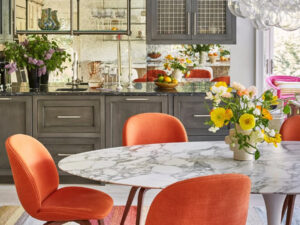
A: Photography right now is about lifestyle. Nothing too fussy or serious. To achieve that look, styling needs to have that effortless appeal. No formal arrangements, but ones that look like they were gathered from the garden moments before. Tree branches and greenery that are foraged from the yard. Arrangements that have a few stems of each variety for a still life look. Sometimes less is more, and sometimes less isn’t enough. A stylist knows the difference. Relaxed styling removes the stiffness from photography—and that’s what makes images feel casually chic.
Q: Are there go-tos at Trader Joe’s or other accessible places that are inexpensive but always perform well for the camera?
A: This won’t be a popular answer, but when you need bulk, hydrangeas are your friend. I know that they are so overused at this point, but if you can get them in a color that’s not stark white, they can be beautiful and are economical. And let’s face it, not every arrangement needs to be a hero or a star. Allow the go-to flowers like hydrangeas to step in and solve the problem of big volume.
Stems with big giant heads are best. If they are too small, then maybe let them go and try something else. I also like to grab roses (the Trader Joe’s “country” roses look the best, in my opinion). I manipulate them to appear larger (sometimes double in size) but massaging the petals to open further. A tight rose is never as pretty as one that is open. I also specifically love orange or yellow tulips. With so many interiors embracing a palette of blue and white, orange and yellow are both nice pops of color without the boldness of red or the sweetness of pink.
Q: And finally, I have a lot of designers asking me if editors really will consider just one room and not a whole project and how/if you prefer to be submitted one room.
A: Step one to getting published is researching the magazines. Look at the columns that they already produce to see if a project that you have might be a fit. That could mean a full house tour and it could mean one single space. Maybe a spreadsheet of magazine columns and then assign your single space to them if you think it’s a fit.
So yes, a single space might be the perfect fit if a publication is working on a color story. They might just need one room. Do they have a column devoted to kitchens? And sometimes you have to be willing to peel off one single room from a whole-house project to fit a publication’s needs. Be flexible and open minded.