By Diane Slug
Last fall, I saw many posts on social media promising makers they could teach them (for a fee, of course) how to get their products into
Holiday Gift guides.
These ads ran in October, November, and even early December. To be honest, they upset me a bit. There were several reasons why. Most of all, it was because the timing was ridiculous.
The idea of self-promoting your work to national media is possible. It just requires basic knowledge about publishing businesses, solid preparation, and persistence.
That is why I decided to contact my wonderfully generous friend, Amy Flurry, who just happens to be THE person who years ago, began to teach makers and business owners how to work the public relations game. Her book, Recipe for Press: Pitch Your Story Like the Pros & Create a Buzz, is the must-read bible for anyone who wants to achieve national media recognition.
Amy is a creative maker and the marketing guru for many well-known home décor brands. Read more about her at amyflurry.com.
Amy shared excellent advice when I interviewed her. First is to familiarize yourself with magazines or blogs that could be interested in your product. Read them to get a good understanding of how and what they feature.
Amy also stresses you must understand how far in advance a publication’s editor works. If you want to be included in a holiday publication, you need to reach out about six or seven months in advance!
For next Christmas, that means right now — in June! For regional or local publications, Amy suggests a four-month lead time.
Second, and this is obvious, you need great photography. You must have a portfolio of professional photos of at least a dozen products, including the product you want to publicize. These photos should be high-resolution, which is best achieved with a professional camera and not your phone, although your phone is great for everyday use.
After years of writing for Sunshine Artist, I have learned that having great, stunning photographs of their work might be the most challenging marketing goal for every artist. However, investing in a high-quality, breathtaking photo portfolio is one of the best choices you can make for marketing your creations.
Also know that if a publication is interested in your product, they may want to photograph it themselves. So, they might ask you to send the product to them.
This is not unusual, because they often have a specific framework in mind. And if you enclose a self-addressed return label, it will be
returned to you.
Amy stresses that publicity is a year-round project because something unique is always happening! We tend to fixate on the winter holiday season, but what you create might be perfect for Valentine’s, Mother’s, or Father’s Day.
If you are a potter, your vase might be perfect for spring blooms, or your apple bakers might make an amazing autumn feature in a cooking magazine. Use your imagination to see where and how one of your pieces can become inspirational!
Look at the audience who read these magazines, ranging from new parents to coastal grandmothers. If you make women’s jewelry, keep in mind that quite a bit of it is purchased by men for special occasions, so pitching “A Perfect Gift for Her” to a men’s magazine might be very shrewd.
Before writing your pitch, do some research to make sure you are sending it to the correct person. The masthead, a page devoted to the editorial staff, is in the front part of every magazine.
Amy recommends looking for an assistant product or editorial manager. If your pitch looks interesting, the manager will forward it to the correct editor.
Now comes the interesting part — crafting an irresistible pitch! First, think of an interesting angle that appeals to the demographic who is reading that publication or blog.
Are they parents trying to amuse their children without using a screen? Or a gourmet couple who like to cook together? Your opening line becomes your title — your hook — and should be exciting and relevant for the audience.
If you can briefly describe why this is timely, do that. If you know a specific section in the publication where your idea fits, mention it.
Include one wonderful hi-res image and offer additional hi-res images if you have them. Never forget the power of the word “new!”
Double check the spelling of the editor’s name and make sure you have included your website and contact infor- mation. Make your pitch informative, timely, relevant, and succinct.
At this point, Amy also recommends making sure your website is in tip-top shape, because that is the first place an editor is going to check you out. You do not want them to see an outdated list of your old events or a slew of unimpressive photos.
She also points out that you do not need a full-blown press kit, because most editors are too busy to wade through pages of information. She suggests using that money for great photography.
Amy is also a huge fan of the humble postcard with your company’s name and website prominent on the front of the card. You can use these as follow-ups to editors you have contacted and thank-you notes to those who show interest in your product.
While this public relations effort may seem beyond the capability of many small creative businesses, Amy stresses that setting aside even a few hours on a regular basis can bring amazing results. She uses the example of R.Wood Studio, where Rebecca Wood sets aside one day each quarter for each of her staff to bring ideas and products to be evaluated and photographed. The result is creative brainstorming that builds a substantial cache of seasonal images they can use for multiple marketing purposes.
I also am including a personal story as a directive to all creatives who wholesale. Be prepared to assist your retail partner if a press opportunity arises for them.
I owned a craft gallery in Charlotte, North Carolina, for about 20 years and was one of the few at that time with an online store. One morning, I got a call from a man claiming he was from Architectural Digest and asking if I had a copper and silver measuring cup. When I answered, “Yes,” he asked if I would send it to him, so the magazine could feature it in their Holiday Gift Guide.
I was incredulous but agreed, feeling it was worth a try. I then called the artist who laughed and said, “Oh, that’s never real.”
He would not make any more, so I bought the few pieces he still had available. As fate would have it, the cup was in the publication.
I sold every measuring cup I had. But my shop and the artist could have sold many more if he had been a bit braver.
Building a business by designing and creating unusual and beautiful handcrafts is daunting. Having the world see, admire, and buy them is the reward.
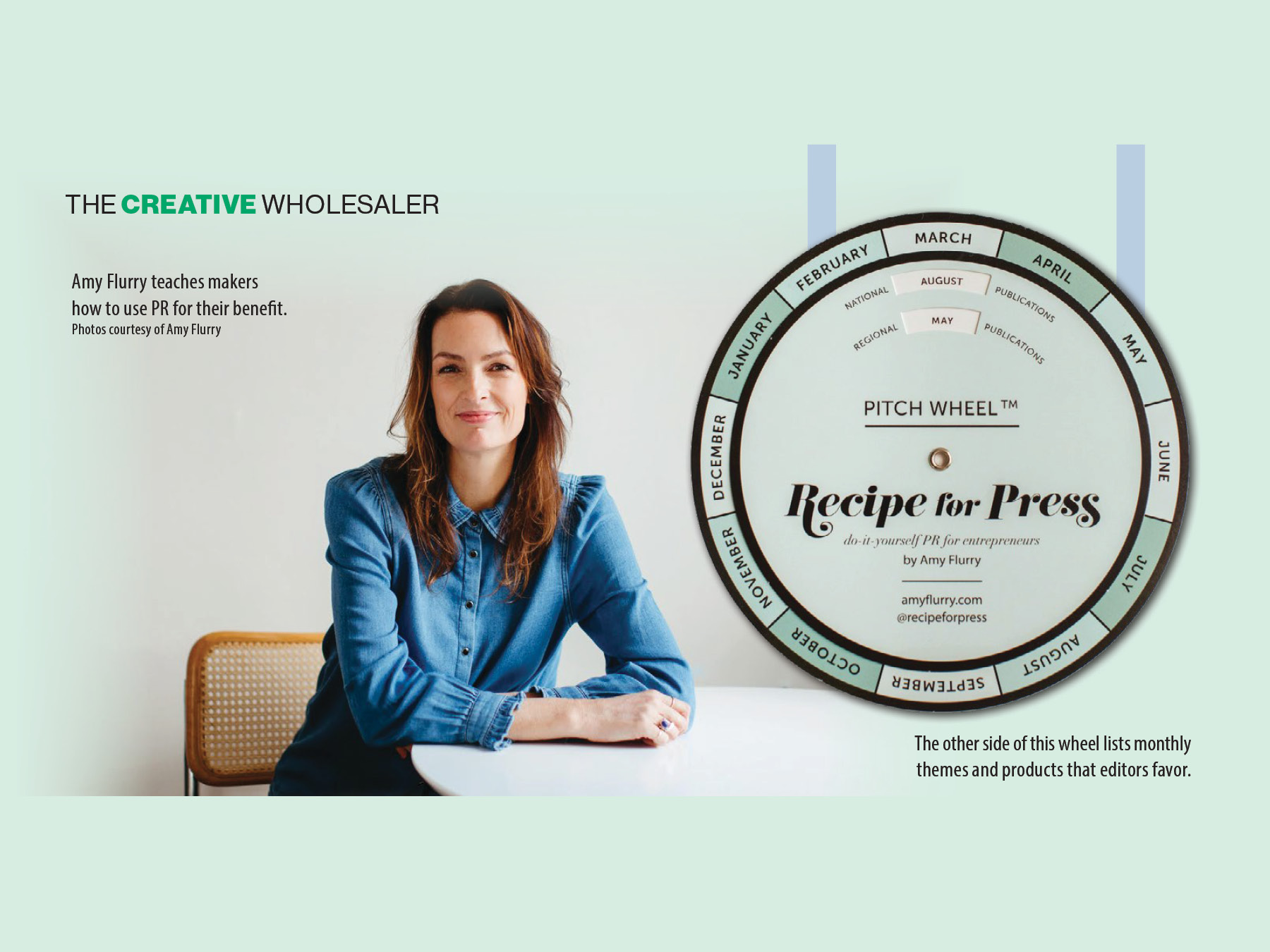
If you are inclined to achieve notoriety on a national scale, look at the learning tools on Amy’s website. She has a simple Pitch Wheel that on the back, lists the monthly themes and products editors favor and, on the front, the month you should contact them if you have an excellent product to pitch. She has a media directory, and of course, the basic PR bible for every ambitious maker, Recipe for Press!